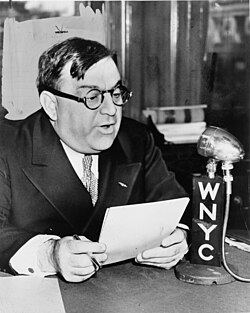
by Joel Denker
To win a city-wide election in New York City, the contender must fashion a coalition of ethnics from its diverse communities. Long before Zohran Mamdani began waging his campaign for mayor, a colorful character with an Italian-Jewish mother, Irene Luzaton Coen, and an Italian father, Achille, ran for office as a Republican. Fiorello H. La Guardia broke ground by assembling such a potent political force. The “Little Flower,” the son of immigrants, was born in the South Village, an Italian enclave in Manhattan, in 1882. Raised in a tenement, the “last white Protestant Mayor of New York,” as sociologist Nathan Glazer dubbed him, would become an Episcopalian. (Glazer wrote this before John Lindsay was elected mayor.)
Elected mayor on the Republican-City Fusion ticket in 1932, Fiorello H. La Guardia lived a peripatetic life. His father, a musician, became an army bandmaster. He was assigned various posts, ending up at a fort in Arizona. Fiorello, who spent an exuberant time in the Southwest, remembered it fondly: “All my boyhood memories are those of Arizona days.” La Guardia would later sport a wide-brimmed western style hat. After his father fell ill, the La Guardias returned with his family to his mother’s home in Trieste. Achille died in 1904.
Soon afterward, young Fiorello trekked to Budapest to take a job in the American consulate. After a stint in Hungary, he left for Fiume (part of modern day Croatia), where he worked as a consular agent. Most of his energy was consumed with helping South Slavs seeking refuge in America.
The tireless wanderer decided to return to the U.S., arriving in New York City in 1906. A quick learner of languages, Fiorello La Guardia was a natural for a job as an interpreter at Ellis Island. Over the years, he taught himself Italian, German, Yiddish, Croatian, French, and Spanish. In a later campaign, he challenged his Jewish opponent, who didn’t know Yiddish, to debate in that language.
La Guardia soon began law classes at New York University. The budding politician developed a camaraderie among the city’s Republicans. He sympathized with their hostility to the Irish-controlled Democratic political machine. To the Republicans, Tammany Hall, the Democratic center of power, was a hotbed of corruption, a menace to good government. Fiorello took to Teddy Roosevelt and his brand of honest, muscular politics and identified with what would become the Progressive Movement. In 1915, he ran for a New York City congressional seat, and won, making him the first Italian American to sit in the chamber.
Two years later, he enlisted in the air force, stationed mostly in Italy. Among his other duties, La Guardia flew combat missions. He was appointed a Major. Restless to return to the political arena, he came back to New York to run again for Congress. Elected in 1922 on the Republican ticket, he represented the city’s East Harlem district, a section with a mixture of Italian and Jewish immigrants. He scored another victory in 1924, running as a Progressive.
In Congress, he found the strongest kinship with western Progressives like George Norris of Nebraska and Wisconsin’s Robert La Follette, for whom he canvassed votes in Wisconsin. In Congress, La Guardia championed the fight for unemployment insurance.
Together with Norris, he also authored the Norris-La Guardia Act, which outlawed the notorious yellow dog contracts. Their provisions made it legal for employers to require their workers to forswear union membership. The statute also limited the use of injunctions by federal courts to stop labor disputes.
La Guardia railed against the congressional campaign for immigrant restriction in the 1920s. Closing the doors to Southern and Eastern Europeans, he said,was a “vicious, cruel discrimination against Italians and Jews.” The congressman also fought for the repeal of Prohibition.
Inveighing against the vested interests, La Guardia spoke up for their victims. When banks beseeched the government to bail them out, La Guardia struck back: “The bastards broke the people’s back with their usury and now they want to unload on the Government. No, no. Let them die. The people will survive.”
La Guardia’s achievements were winning him a national reputation. “Short, stocky, swarthy with rumpled black hair and glistening dark eyes,” historian Arthur M. Schlesinger, Jr. portrays him, “he was possessed of demonic energy. For him life was a perpetual combat, in which he was forever fighting the people’s fight.”
No rooted ethnic, the future mayor had lived a life of wanderlust. An outsider, his coming of age was unconventional preparation for a political career. He was, as historian Arthur Mann points out, the classic marginal man, a quality that endowed the politician with special gifts. “La Guardia was a marginal man who lived on the edge of many cultures, so that he was able to face in several directions at the same time. He was so many persons in one, so uniquely unparochial in that most parochial of cities, that New Yorkers of nearly every sort were able to identify themselves with him.”
When the New York World asked the future mayor about his background, Fiorello said he was a total outsider: “I have no family tree. The only member of my family who has one is my dog Yank. He is the son of Doughboy, who was the son of Tannhauser, who was the son of Woton. A distinguished family tree, to be sure—but after all, he’s only a son of a bitch.”
Ambitious for higher office, La Guardia decided to run for New York City mayor in 1933. Standing on the combined Republican and City Fusion ticket, his backing came from independent Democrats, Republicans disgruntled with their party, and good government voters from Manhattan’s Upper East Side’s Silk Stocking district. His allies shared with their standard bearer a repugnance for the graft-ridden Irish Democratic Tammany Hall machine. To break Tammany Hall’s iron grip on the electorate, La Guardia was convinced, he needed to woo the city’s more recent immigrants, the Italians and the Jews. But he would not run as an Italian candidate. He would count on the immigrants’ yearning for recognition and acceptance. For too long, the Irish bosses had taken the Italian Democratic vote for granted.
Fiorello instinctively understood his audience. The Italians were itching for one of their own to be elected. A flamboyant racketeer, Schlesinger discovered, perfectly captured their desires. In 1933, Joe Adonis declared: “There is no reason for the Italians to support anybody but La Guardia. The Jews have played ball with the Democrats and have gotten nothing much out of it. They know it now. They will vote for La Guardia. So will the Italians.”
La Guardia’s campaign, historian Ronald H. Bayor observes, stirred pride among the city’s Italians. The candidate received letters of support from families written in Italian. The magazine, The Sons of Italy, made a strong case for the aspiring mayor: “…in helping to elevate one of our race to an important public office it must be remembered that we are helping ourselves and our individual aspirations for future realization.”
La Guardia’s victory was greeted joyously with bonfires and torchlight parades in Italian neighborhoods. The Italian American newspaper, Il Progreso, applauded the triumph of the underdog. “Only a few years back, we were in last place; today the Italians are able to decide the outcome of a great contest and bring Fiorello H. La Guardia to one of the highest and most valued public offices in the country.” His win aroused fear among the chieftains of Tammany Hall. The machine’s lock “in the most Irish of all cities” on the political spoils was eroding. Irish immigrants depended on the party organization to protect them from hardship and to get them jobs. The Democratic Party had shrewdly welcomed the newcomers, while the parties of older stock Americans—the Federalists, the Whigs, the Republicans—had snubbed them. The Irish were branded as carriers of crime, disease, poverty, and corruption. The “Papists,” their enemies claimed, enjoyed the secrecy and hierarchy of the Church. Worst of all, their loyalty to Rome, a foreign authority, made the immigrants suspect.
Although the Irish labored on the docks, building sites, factory floors, and railway yards, the jobs of choice were government blue- and white-collar positions dispensed by Tammany. Slots in the police and fire departments were especially prized. For Irish women, public school teaching jobs were coveted.
Over three La Guardia administrations, the Irish niche in the public sector crumbled. In teaching, better educated Jews began supplanting the Irish. In 1914, Jews occupied only 22 percent of new teaching jobs in New York City schools, according to a study cited by Bayor. By 1940, their share had soared to 56 percent.
In the civil service, being Irish and a Democrat was no longer a sure ticket to a secure job. The mayor weakened the power of patronage by making government posts more competitive. A high school diploma was increasingly required for employment. Jewish candidates with more schooling had a leg up over their ethnic rivals. More of the city’s appointed positions were also going to Jewish New Yorkers. In 1938, they landed six out of fourteen deputy commissioner posts.
Angry about the alleged favoritism, resentment boiled up among the Irish. Pat Scanlon, editor of the Tablet, a paper aimed at an Irish Catholic readership, urged his audience to compete for civil service jobs. Irish Catholic agitators painted Jews in government jobs as “Reds” or “Communists.” “The Reds,” the Social Justice journal backed by the nativist radio priest, Father Charles Coughlin, warned, would soon be supervising their Irish underlings in the police force. The publication asked whether now “a man must be up on his Greek, mathematics, zoology, astronomy, and Hebrew before he can become a good cop.”
As the 1936 mayor’s race loomed, socialist trade unionists in the needle trades were hatching a plan to enhance La Guardia’s and Roosevelt’s support in the upcoming election. The socialist movement in New York City was attracting growing interest among the Jewish working class. A new ballot line, unionists like David Dubinsky, president of the garment workers union, argued, would encourage sympathetic voters to vote for both the mayor and the President on a mainstream ticket. “The real question,” as Dubinsky put it in his autobiography (written with Abe Raskin, the late labor correspondent for The New York Times) was “how to get the socialists, who numbered tens of thousands in and out of the unions, to vote for FDR.” Since he did not want to be tagged as a “socialist,” the plan pleased the President. For La Guardia, no friend of the Democrats, whom he regarded as venal and corrupt, the scheme offered a way to capture voters disgusted with Tammany.
The American Labor Party (ALP) was born on July 16, 1936. David Dubinsky, a diminutive Jewish socialist, was the spark plug behind the party. (His lieutenant and party strategist was Alex Rose, president of the Hatters, Cap and Millinery Workers Union). The Russian-born activist, Dubinsky, worked as a baker in his father’s shop. The master bakers stacked the finished loaves on his bed in the cellar. Dubinsky threw himself into Russia’s socialist movement. Punished as a young man for his beliefs, he was arrested at 15 and again at 16 and sent to jail in Siberia for 19 months. Journalist Stephen Isaacs describes his ordeal: “Hiking for days across Siberia, sneaking aboard railroad trains and because of his small size, curling into a ball and hiding underneath the benches on the trains, behind passengers’ legs.”
The 18-year-old took refuge in New York City. Soon after his arrival in 1917, the born campaigner honed his skills speaking at street corners and meetings, promoting the socialist cause. Both a socialist and trade unionist, he also adopted a communitarian creed. In an early venture, Dubinsky and nine friends organized a cooperative restaurant in a basement on 10th Street in Manhattan. A place for a cheap meal—a dinner cost 25¢—the spot was a meeting ground for new immigrants and an incubator for the socialist cause.
Dubinsky was a relentless organizer. Political analyst and pollster Samuel Lubell recounts the activist’s memories of one campaign: “I made speeches from a soapbox and was an election watcher. I slept for three nights with my wrist strapped to the ballot box so Tammany leaders wouldn’t throw the ballot box into the river.”
Dubinsky found a job in a garment shop and climbed the rungs to become a skilled cutter. He won election in 1932 as the president of the 400,000 member ILGWU. Dubinsky and his compatriots distinguished their brand of unionism from the business unionism of the old line trades. Alex Rose summed up the difference: “They looked upon their union as an instrument for bread and butter, whereas the Jewish unions looked upon their unions as an instrument for social advancement, not only for their members but for society.”
The ALP strategy was a stroke of political genius. The mayor, who also ran as a Republican-Fusion candidate, amassed 487,128 votes on the labor line—a third of the total vote and more than the margin of victory. Jeremiah Mahoney, his Tammany Democratic opponent, was thrashed and the supposedly invulnerable Irish political machine was pierced.
The Jewish vote was critical to his victory. La Guardia won 70 percent of the group, an increase of 35 percent over the 1933 tally. Forty percent of Jewish voters pulled the ALP lever for the mayor. The result taught La Guardia a valuable lesson—that Jewish support, wavering in the past, was now a prerequisite for victory. The Irish were no longer power brokers. If La Guardia could hold on to the Italians and bolster his Jewish base, he had a formula for winning.
As the years went on, tensions abroad inflamed large segments of New York’s Irish and Italian communities. Fascism was on the march and Americans debated whether or not to intervene in the European conflict. The Spanish Civil War, which broke out in 1936, was a flashpoint, prompting the city’s ethnics to choose sides in the battle between Franco’s forces and his Republican opponents. In New York City, the followers of Father Charles Coughlin, the Irish Catholic priest, mostly backed General Franco and denounced Russian aid for his enemies.
Many Catholic clerics cast the Civil War as a battle between Communism and Americanism. It was, they argued, a struggle to preserve Spain’s Catholic Church from those who would destroy it. Coughlin’s immensely popular Sunday radio tirades against FDR and the Communist threat were rousing many Irish working class voters in the city’s neighborhoods. La Guardia and his supporters were favorite targets of the Coughlin backers because of their alleged ties to Communism.
Since many Jewish Americans were vocal supporters of the Spanish Republicans, the Coughlinites laced their battle cries with antisemitic venom. Followers of the pro-Coughlin Christian Front in New York City staged street corner rallies stoking hatred against the “Jewish Communists.” Jewish businesses and synagogues were vandalized and marauders mugged defenseless passersby. Jewish-owned shops were boycotted.
Irish Catholics, once taunted as subversives themselves, seemed eager to prove their patriotism. Political analyst Lubell explained the Catholics’ attraction to the anti-Communist crusade: “The Communist issue is almost the first political cause which has given Catholics generally the chance to feel more American than other Americans.”
In the 1941 mayoralty election, La Guardia’s triumphant victory underscored the divide between Irish and Jewish voters. The Irish vote for the mayor, modest as it had been, plummeted. Tammany Hall, the Irish stronghold that had dominated the city’s politics, was on its last legs.
A fervent Jewish vote swept La Guardia into office. The mayor’s strong stand against anti-semitism, the menace of fascism, and his drive for a clean, progressive government, untainted by machine-style corruption, brought him 73 percent of their vote, his best effort ever. In La Guardia’s antipathy to the Irish Democrats, the Jews saw a kindred spirit. The mayor garnered support across all economic groups in this community.
In search of a patron in a hostile environment, the Jewish community finally found one in La Guardia. The new immigrants had nothing but unpleasant experiences with Tammany Hall. It was their vote, not their welfare, that the bosses wanted. Some Irish leaders boasted of their political genius, an acumen they said the Jews lacked. One Tammany politician, George Olvany, Bayer reports, applauded Irish superiority. “The Irish are natural leaders. The strain of Limerick keeps them at the top. They have the ability to handle men. Even the Jewish districts have Irish leaders. The Jews want to be ruled by them.”
Superior or not, the Irish had to woo Jewish voters in order to win. Reluctantly, many Jewish voters, despite their misgivings, pulled the Democratic lever.
The Republicans saw an opening, an opportunity to capitalize on the Jewish distaste for the Irish machine. Their candidates approached the immigrants with a softer, more progressive touch than did the Democrats. As millinery union leader Alex Rose remarked, the choice was simple for ethnics who couldn’t tolerate Tammany: “If you wanted to be part of an anti-Tammany political organization, you had to go to the Republicans.”
The experience of Morris Javits, the father of the late Republican Senator Jacob Javits from New York, typified the Irish-Jewish relationship. Morris, who was the janitor for three buildings on the Lower East Side, was pressured by the machine. Journalist Isaacs tells his story: “The Tammany saloon keeper down the block would give Morris Javits two dollars per voter in the three buildings and Morris’ job was to distribute the money so that the new citizens would vote for all of Tammany’s candidates.”
A Jewish candidate running on the Republican line could win. One savvy Lower East Side politician, Sam Koenig, rose through the ranks of the Republican Party. The Hungarian Jew won the post of Republican district leader in the Lower East Side’s tenth assembly district in 1911. Historian Chris McNickle commented that “Koenig’s tactics combined street smart politics with progressive candidates.”
The Italian voters who previously abandoned their Irish overlords to vote for La Guardia, rejoined the Democrats in the 1941 election. They grumbled that the mayor shunned them and that they were not receiving the patronage they deserved. The inviting welcome mat at city hall was now tattered.
La Guardia’s ties to Roosevelt also made him suspect. FDR’s denunciation of Mussolini’s invasion of France in 1940 damaged the Italians’ ties to the mayor: “the hand that held the dagger has plunged it into the back of its neighbor,” the President exclaimed.
The Italians had never really been ardent New Dealers. They were more entrepreneurial than the Irish, who depended on government influence for contracts, licenses, and other favors in their waterfront and construction businesses. Intent on being their own masters, the Italians built restaurants, specialty stores, groceries, and import houses. The Italians were consumed with a “business spirit,” Nathan Glazer points out, and lacked a “strong socialist, liberal, or labor tradition and ideology.” In New York, as their lot improved, they pressed politicians to advance their interests as taxpayers and homeowners. Republican and Conservative Party candidates tried to capture their votes.
Beginning in the late 1930s, Italian gangsters put the squeeze on the Tammany machine, demanding favors in exchange for payoffs. As long as the cash rolled in, the Democratic bosses acquiesced to the mob’s demands. Frank Costello (born Francisco Costiglia), the boss of the Genovese crime family, was a kingmaker, winning appointments for his compatriots. In the process, Italians replaced Irish district leaders. In one coup, Costello secured a nomination for City Magistrate Thomas Aurelio for a New York State Supreme Court judgeship. Aurelio called the mobster to thank him. Costello responded, “When I tell you something is in the bag, you can rest assured.” New York D.A. Frank Hogan preserved the reply through a wiretap on Costello’s phone.
Onward to Mamdani
It is tempting to view La Guardia and Mamdani, shrewd practitioners of ethnic politics, through the same lens. They were both crusaders for the all-too-often forgotten immigrants who were transforming their city. But the men were not cut from the same cloth.
Although both came from immigrant backgrounds, their upbringings were quite different. Mamdani, who regarded the “Little Flower” as the city’s preeminent mayor, lived a more cosmopolitan life than his hero. His father, Mahmoud Mamdani, is a distinguished scholar and professor and his mother, Mira Nair, a filmmaker. Nonetheless, as a Muslim, Zohran suffered the prejudice that people of this faith endured.
To use biographer Arthur Mann’s characterization, La Guardia was more of a “marginal” man. Raised in a tenement in an Italian neighborhood in Greenwich Village, he enriched his background with stints in the air force and as a counselor for immigrants in Trieste and Ellis Island. His father, an Italian, took the family to Arizona, where he worked as an army bandmaster. His mother was Jewish, from a prominent Sephardic family in Trieste. Fiorello joined the Episcopal Church. The mayor spoke several languages, reveled in the American Southwest, and, as Arthur Schlesinger, Jr., portrayed him, was a “cocky and exuberant youth whose experience stretched from the Arizona frontier to the crowded steerage of immigrant ships and to the multinational complexion of the Austro-Hungarian empire.”
Both politicians concentrated on winning over immigrants, who felt slighted and ignored. Muslim voters were critical to the Mamdani campaign. Their turnout soared, according to one estimate, from 22,000 in the last mayoral race to 66,000 in this one. Drawing Italians and Jews into his fold was La Guardia’s mission. First the Italians, who had previously cast their votes for Tammany Democrats, and then the Jews, a constituency courted by both the Republicans and the Socialists, joined his victorious coalition.
The two leaders, however, brought radically different world-views to their struggles. Mamdani, who ran on issues of “affordability” and inequality, recruited both immigrants and college-educated professionals and activists. Mamdani ran as an avowed democratic socialist. La Guardia was no socialist. Fiorello was more of a “Progressive,” in the Teddy Roosevelt mold, advocating for economic and regulatory reforms and for honest, efficient government—but not for large-scale overhaul.
Both politicians relied on trade unions for support. La Guardia, the non-socialist, depended heavily on socialist unions, particularly from the needle trades. David Dubinsky, Alex Rose, and Sidney Hillman—all Jewish labor leaders—built an organization, the American Labor Party, that propelled his campaign. These unions, unlike Mamdani’s labor backers, sat in the cockpit of the La Guardia movement.
Both La Guardia and Mamdani were insurgents. Mamdani battled the political establishment and financial elites. La Guardia’s goal, on the other hand, was to dethrone the Irish-controlled Democratic Party, whose titans reigned over their countrymen and who did their best to corral the reluctant Italians and Jews. For La Guardia, the Irish machine was not just corrupt. It was a barrier to real social reform.
La Guardia succeeded in making the Jewish community the keystone of his campaign. The combination of a social justice platform, along with an emphasis on labor issues and a strong crusade against rising fascism and anti-semitism, won him ardent Jewish support.
While international crises bolstered La Guardia’s Jewish support for the Mamdani campaign, upheaval abroad in the Middle East created divisions in the Jewish community. For Mamdani, the new mayor’s criticism of Israel’s war in Gaza excited many of his Jewish voters, but also alienated others from that community.
La Guardia’s battles with the intricacies of New York’s ethnic politics resembles one Mamdani is likely to face. A few examples: The mayor has won over both beleaguered wage earners as well as the entrepreneurially minded. But these factions may not always agree about worker and tenants rights or business regulation.
Ethnic groups are not monolithic. The Indians, for example, who migrated from East Africa, like Mamdani’s family did, included educated professionals as well as merchants from trading castes like the Patels, who played a dominant role in the region’s small business.
Among Mamdani’s allies are also immigrants fixed on jobs in the civil service. The Bangladeshis, a rapidly growing community in New York City, have established a beachhead in government. Their initial stepping stones were jobs as traffic enforcement agents, charged with handing out parking summonses. One agent, a former airport security guard, told a New York Times reporter why this was a promising occupation. “I saw a lot of Bengali people walking around the city, writing tickets.” After asking them about their jobs, he said, “I was surprised. They told me this was a very easy job to get.” Talking to the reporter, Shah Nawaz, an insurance broker, extolled the rewards of city employment. These posts had become “a source of pride for a new generation of Bangladeshis.” Nawaz’s bookkeeper, married to a traffic enforcement agent, added, “It is a very prestigious job.”
For many Bangladeshis, these positions have become pathways to employment in the city’s police department. The Bangladeshi American Police Officers Association, Times reporter Maia Coleman notes, boasts a membership of 1,000 in the roughly 34,000 uniformed force. Other groups have followed suit. The fastest-growing ethnic organization is the New York Dominican Officers Association.
As the Bangladeshis fortify their niche in the city government, they will undoubtedly confront rival groups seeking jobs. Recall the skirmishes in the civil service in La Guardia’s day between the Irish and the Jews. Since Mamdani strenuously cultivated Bangladeshi support in his campaign, his ability to mediate between competing voting blocs will surely be tested.
Mamdani may not be La Guardia’s descendant, but he has inherited the “Little Flower’s” legacy of spunk and energetic civic spirit. When he earlier ran for a state assembly seat from Queens, the new mayor’s campaign slogan was “Roti and Roses.” La Guardia would certainly have approved.
Suggested Reading
An excellent 2-volume biography of La Guardia by historian Arthur Mann, La Guardia: A Fighter Against His Times and La Guardia Comes to Power: 1933, provides a myriad of interesting details about his life. Ronald H. Bayor has written a more recent study: Fiorello La Guardia: Ethnicity, Reform, and Urban Development. Two books skillfully examine New York City’s ethnic politics, Ronald H. Bayor, Neighbors in Conflict, and Chris McNickle, To Be Mayor of New York. An older volume, Beyond the Melting Pot, by Nathan Glazer and Patrick Moynihan, contains valuable nuggets about the interplay of ethnicity and the political life of the Empire City.
Samuel Lubell, the late pollster and political journalist, makes incisive observations about immigrants and American politics in The Future of American Politics and The Revolt of the Moderates. The Protestant Establishment, Aristocracy and Caste in America, by sociologist E. Digby Baltzell, portrays La Guardia in his investigation of the book’s larger theme. Arthur M. Schlesinger, Jr.’s The Politics of Upheaval, Vol. III of his Age of Roosevelt, contains fascinating material about La Guardia, Huey Long, Father Charles Coughlin, and other insurgents from the right and left during the Depression.
David Dubinsky, A Life with Labor, by David Dubinsky and A.H. Raskin, tells the engrossing story of a labor leader who played a central role in La Guardia’s triumph. Norman D. Isaacs, Jews and American Politics, is an illuminating account of a group so vital to the Mayor’s ascent.